
Filmmaker Mark Mori’s new documentary Baristas vs. Billionaires opens with a disclosure: Despite repeated requests, coffee mega-corp Starbucks declined to participate in the making of the movie. That refusal becomes part of the film’s DNA, yet the absence of the company’s voice leaves the documentary leaning heavily toward advocacy. The film champions workers’ rights with conviction and moral clarity, but it struggles to examine the larger systems that enable corporate exploitation. Without hearing from corporate leadership or industry experts, the conflict risks being reduced to a simple narrative—management is greedy and out of touch.
What we are left with is a portrait of the Starbucks baristas who have and continue to organize against overwhelming odds. Their passion is compelling, and the film’s heart is unquestionably in the right place. Viewers, however, might find themselves craving a deeper exploration of the economic and structural forces that drive a multi-national corporation’s relentless pursuit of shareholder value, often at the expense of worker safety, stable hours and even its own reputation. That no one from the company appears on camera is certainly revealing, but Mori not replacing that absence with analysis from economists or labor scholars or even corporate accountability experts limits the film’s scope.
The documentary arrives in a moment defined by mounting economic frustrations. Songs like Oliver Anthony’s 2023 “Rich Men North of Richmond” (featured in the film, and on my most annoying songs of all time list) have helped turn working class anger into viral content, yet that rage is often directionless and more about catharsis than action. What Baristas vs. Billionaires shows instead is agency. It frames unionization not as nostalgia for a bygone era, but as a generational rebellion against greed and apathy, mirroring a nationwide resurgence of labor activity at companies like Amazon, REI, Trader Joe’s and even Santa Fe’s Meow Wolf (the Meow Wolf Workers Collective ratified its contract in 2022). In that sense, the film becomes more than a portrait of Starbucks workers and their trials and tribulations, but a recognition of a shift in American consciousness. Still, the issues on display create a vivid, ground-level picture of what is happening to workers across corporate America and the subtle, insidious anti-union strategies companies deploy to maintain control. In this regard, the film succeeds even if technical issues blunt its emotional impact.
Technically, the film is effective with tight editing and confident pacing that holds the narrative together. Some shots are noticeably soft or out of focus, which undercuts perceived professionalism even as voiceover from Susan Sarandon adds clarity and structure where interviews cannot. The filmmakers seem less concerned with polish than with capturing the lived reality of low-wage service workers, anyway. At times, though, the lack of visual style punctuates what feels like missed opportunity. This is a film built largely around talking-head interviews that could have benefited from stronger aesthetic choices than a burning candle or a red leather couch in the background. Still, given the subject matter, the scrappiness of the production lends a certain authenticity to its underdog story.
Stylistic criticisms aside, the unionization of Starbucks is a story worth telling. From what the film presents as plainly illegal union-busting tactics to its portrayal of billionaire executive Howard Schultz as a bumbling sort, the journey is undeniably engaging. The courage displayed by the young workers at the heart of the organizing efforts is inspiring as well, especially within a national climate where faith in institutions is crumbling.
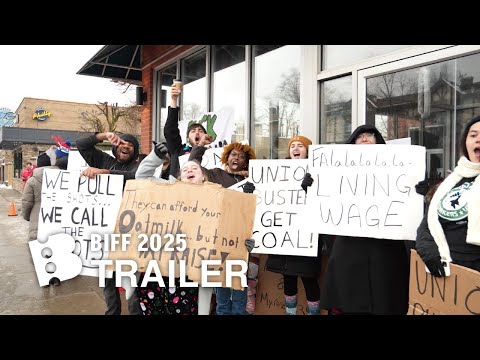
The film begins with a handful of Starbucks employees in Buffalo, New York, working through the pandemic and quickly realizing the disparity between the brand’s progressive public messaging and its disregard for its workers. The unlikely bunch, made up almost entirely of Gen Z and Millennials, decides to get the ball rolling on organizing for fair treatment. What follows are a variety of union busting tactics from the corporation, from psychological games like flying in high level executives to keep an eye on store activity to firing staff with very little to combat the argument that said firings were retaliatory. Watching the movement gain momentum and members in the face of the company’s petty behavior is truly satisfying in a way that will hopefully inspire those in similar circumstances to band together to fight for better working conditions for themselves—and ultimately the working class as a whole.
“Seventy percent of Americans now approve of labor unions—the highest level in 60 years,” the film’s executive producer Glenn Silber tells SFR. “Showing young people organizing isn’t just inspiring, it’s proof that fairness is still possible when people band together.”
In a time where massive and strangely ubiquitous corporations seem to be salivating at the prospect of firing workers or finding ways to pay them the smallest amount possible while executives rake in millions—or billions—of dollars with minimal taxation, it seems more important than ever that the working class begin to recognize and bolster through collective bargaining. Baristas vs. Billionaires reminds us of the power that we hold as the many, if only we can stand as one. While Mori’s film misses an opportunity to better educate its viewers regarding the economic circumstances that lead so many large organizations to treat its workers so callously, what it achieves in its worker’s rights advocacy stands to make a significant impact for the right audience and, ultimately, it showcases what a couple of punk kids can accomplish in the face of corporate tyranny.
Baristas vs. Billionaires opens Friday, Nov. 14 at the Center for Contemporary Arts. Visit ccasantafe.org for screening times