

Though true that director Paul Greengrass has made awesome movies before (like The Bourne Identity, for example), his newest foray for Apple TV+ feels undercooked at best and phoned-in at worst. Now, whether that’s down to the tedious writing or the silly little ways the film tries to ramp up the drama is kind of a toss-up, but at the end of the day, The Lost Bus mostly feels unnecessary.
Based on the 2018 fire in Paradise, California—the deadliest in that state’s history according to a post-movie text crawl—Greengrass’ fire flick attempts to merge concepts we’ve seen in movies like Backdraft and Speed. Sadly, however, the results mainly feel like its makers packed a bunch of not-so-perilous peril on top of an admittedly terribly sad story for sensationalist reasons rather than storytelling.
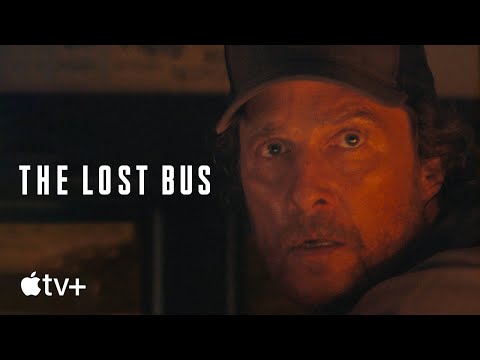
In The Lost Bus, Matthew McConaughey plays the based-on-a-real-guy Kevin McKay, a Paradise native who returns home after decades to take care of his mom after his dad dies. With him is his son, a mostly off-screen Levi McConaughey (dang, nepo babies), with whom our hero Kevin has a strained relationship. Our guy has taken a job as a school bus driver to make ends meet, but the opening minutes of the film marry Kevin’s new reality with a borderline absurd series of sad little events so rapid-fire it’s almost funny: His mom’s not well, he’s recently divorced, his son says he hates him, his dog has cancer and Kevin’s struggling to manage his time and do well at the new job—he’s not getting there.
Then the power line falls, sparking the fire. The rest of the film phases between emergency workers trying to handle the blaze and Kevin getting swept up in a last-minute elementary school evacuation alongside based-on-a-real-lady Mary Ludwig (America Ferrera). Uh-oh, though, Kevin’s son barfed earlier that day, so he makes a big show of buying Tylenol and stressing about getting it to him for, like, a really long time. At some point, at least, the importance of the lives of the 22 kids on the bus takes over, and Kevin and Mary attempt to navigate the growing fire and get those kids to their parents at an emergency rendezvous out of town.
The Lost Bus certainly sells the intensity and drama of fire and just how quickly it can move. As for intensity and drama between its leads? McConaughey and Ferrera do their best with tales of shoulda-woulda-coulda while the kids on the bus go round and round with shrieks of “I wanna go home!” and “what’s happening!” and “I’m scared!”
None of this criticism of the film itself is to minimize the real-life events of the Paradise fire, nor the 85 deaths a judge ultimately decided were caused by Cali power company PG&E. One wonders, though, whether it was worth it to tell the story in this specific way—one wherein a puking teenager seems to be the bulk of the motivation for our hero and wherein we must hear Ferrera shout, “Ohmygod!” ad nauseam.
New Mexicans can take at least some solace knowing the production brought money to Santa Fe, Ruidoso and a couple other locations wherein the film was shot. But just because a production employed locals doesn’t make it good, and the real value of The Lost Bus might be in how it raises a pair of important questions: Should we make movies about real-life tragedies if they require filmmakers to tack on barely-there dramatics? And wouldn’t a documentary be more informative?
The Lost Bus
Directed by Greengrass
With McConaughey and Ferrera
Apple TV+, R, 129 min.